
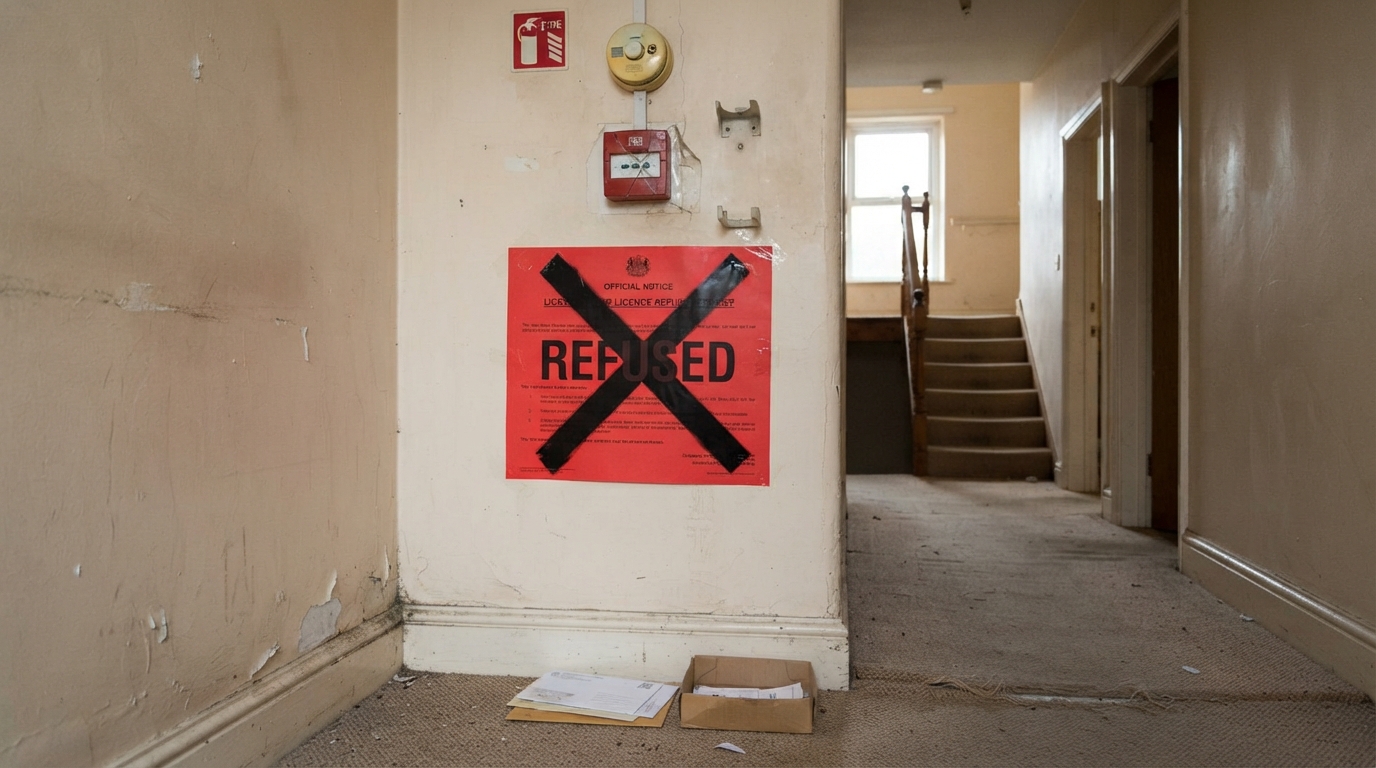
The case highlights the potentially serious consequences for landlords who fail to address safety issues identified by letting agents, councils or fire safety authorities.
According to Property Industry Eye, Glasgow City Council's licensing committee rejected the landlord's application to renew the licence for a flat on Sauchiehall Street.
Serious safety concerns identified
The property had been inspected by Glasgow City Council's HMO team and the Scottish Fire and Rescue Service.
Multiple safety problems were identified.
The property was occupied by five tenants, making fire safety particularly important given the risks associated with shared accommodation.
The case also involved an important piece of evidence: the letting agent told the licensing committee that repair quotations had previously been sent to the landlord.
The landlord allegedly rejected the quotes rather than proceeding with the recommended remedial work.
Why HMO fire safety is different
Houses in multiple occupation have additional safety considerations because several unrelated people may occupy the same building.
Residents may have different sleeping patterns, cooking arrangements and levels of familiarity with the property.
A fire that might be manageable in a conventional single-family home can become considerably more dangerous where multiple households occupy the same building.
This is why HMO licensing and fire safety requirements can be more demanding.
A licence is not simply an administrative document
One of the most important lessons from the case is that an HMO licence should not be viewed as a piece of paperwork that can be renewed indefinitely.
Licensing authorities can consider whether a property is suitable and whether the landlord is complying with relevant requirements.
Where serious safety problems remain unresolved, licensing consequences can follow.
Why ignoring professional warnings is risky
Landlords often rely on letting agents, contractors and property managers to identify problems.
That creates an important responsibility.
If an agent reports a serious defect and provides a quotation for remedial work, the landlord should not simply ignore the issue.
A landlord may disagree with the price or seek another quotation, but there should be evidence that the underlying safety problem is being addressed.
The Glasgow case illustrates why written communication matters.
What HMO landlords should document
HMO landlords should maintain comprehensive compliance records covering:
-
HMO licence
-
Fire risk assessments
-
Fire alarm inspections
-
Emergency lighting
-
Electrical safety
-
Gas safety
-
Portable appliance testing where applicable
-
Fire doors
-
Escape routes
-
Maintenance records
-
Repair requests
-
Contractor reports
-
Inspection dates
-
Certificates
-
Communications with tenants and agents
The precise requirements vary according to the property and local authority.
Do not wait for an inspection
One common mistake is treating compliance as something that only matters when a council inspection is approaching.
That approach can be dangerous.
Fire safety should be managed continuously.
Landlords and agents should have procedures for identifying defects and ensuring that repairs are completed.
A damaged fire door, defective alarm or obstructed escape route can become a serious issue long before the next scheduled inspection.
What should landlords do when a repair is expensive?
Cost alone does not eliminate a landlord's responsibility to keep a property safe.
If a recommended repair appears expensive, landlords can:
-
Obtain a second professional opinion.
-
Obtain alternative quotations.
-
Establish the urgency of the work.
-
Document the decision-making process.
-
Complete urgent safety work without unnecessary delay.
-
Keep invoices and completion evidence.
The objective should be to resolve the safety issue rather than simply minimise expenditure.
What about tenants?
Tenants also have a role.
Residents should report safety concerns promptly and avoid blocking escape routes or interfering with safety equipment.
However, the legal responsibility for maintaining a compliant HMO remains a serious obligation for the landlord.
A warning for portfolio landlords
The case is particularly relevant to landlords operating multiple HMOs.
A portfolio may contain several properties with different licensing conditions and maintenance requirements.
A landlord managing five, ten or twenty properties cannot safely rely on memory.
Digital compliance calendars and property-management systems can help track:
-
Licence expiry dates
-
Inspections
-
Certificate renewals
-
Fire safety checks
-
Repairs
-
Contractor visits
The wider lesson
The Glasgow case is a reminder that HMO investment is not simply about achieving a high rental yield.
HMOs can produce attractive rental income, but they also carry additional management, licensing and compliance responsibilities.
The cost of failing to address serious safety concerns can be much greater than the cost of carrying out the original repair.
For HMO landlords, the safest strategy is therefore straightforward:
Identify problems early, act promptly, document the work and never treat fire safety as optional.
Source: Property Industry Eye report on the Glasgow HMO licensing case.
Disclaimer: This article discusses a reported licensing case and is intended for general information. HMO requirements vary by local authority and property type. Landlords should obtain appropriate professional advice.

0 Comments
No comments yet. Be the first to share your thoughts.